
Insights
The Compromised Keyholder: How Social Engineering, Dark Web Reconnaissance, and Physical Coercion Have Turned the Human Layer Into Crypto’s Primary Vulnerability
The primary cause of recent multi-million dollar crypto exploits is the systemic targeting of the human layer—specifically cryptographic keyholders and governance signers—rather than software vulnerabilities. Attackers use sophisticated social engineering, deep web data aggregation, and physical duress to bypass smart contract code, turning individual keyholders into the weakest link in institutional digital asset custody frameworks.
The Shift in Vector: Why Hackers Abandoned Code for the Governance Control Plane
For years, institutional digital asset security focused almost exclusively on hardening smart contract code and auditing protocol layers. However, recent major exploits show a structural transition in attacker methodologies. Rather than seeking software bugs, sophisticated threat actors now infiltrate the governance control plane by targeting the people holding administrative permissions.
The prime example occurred on 1 April 2026, when Solana’s leading decentralized perpetual futures exchange, Drift Protocol, was drained of US$285 million (representing over 50% of its Total Value Locked) in a matter of 12 minutes. The attack did not exploit a vulnerability within Drift's smart contracts; instead, it was a governance-layer failure driven by an extensive social engineering campaign.
The threat actors spent months building trust with key stakeholders, posing as a legitimate quantitative trading firm. They leveraged Solana’s "durable nonce" account feature—which allows transactions to be digitally signed in advance and executed later—and manipulated Drift Security Council members into pre-signing transactions that appeared routine but contained hidden administrative authorizations. Once the council migrated to a 2/5 multisig configuration and eliminated timelocks, the attackers deployed the pre-signed transactions, whitelisted a worthless fake token (CarbonVote Token) as valid collateral at an artificial US$1 valuation, and drained real protocol vaults containing USDC and JLP.
This governance infiltration pattern was mirrored in June 2026 by the Humanity Protocol exploit. A Layer-2 blockchain focused on digital identity, Humanity Protocol suffered a severe breach when wallets associated with the project were targeted via a private key compromise belonging to a member of the Humanity Foundation. The attackers bypassed the protocol’s advanced palm-recognition and zero-knowledge identity tech by simply capturing the underlying structural key, draining more than US$30 million and causing the native H token to crash by roughly 80% to 90% in a single day.
The Rise of the Cryptographic "Wrench Attack": Physical Duress and Organized Local Syndicates
When digital defences are too secure to penetrate remotely, organized crime networks transition from cyber infrastructure to physical violence. This hybrid threat is colloquially known as a "wrench attack"—a physical coercion event where criminals use kidnapping, home invasions, or violent confinement to force asset holders to unlock their devices and execute irreversible on-chain transfers under duress.
According to global security metrics compiled in late 2025, physical coercion has officially evolved from an isolated edge-case risk into an organized, transnational threat vector.
Key Global Trends in Physical Coercion
Exponential Increase in Violence: Verified physical coercion incidents worldwide spiked by 75% year-on-year, driven heavily by organized syndicates operating in major financial hubs.
Brutality Escalation: Physical assault rates connected to asset extortion rose by 250% over a 12-month trailing period, proving that attackers prioritize rapid capitulation over stealth.
Geographical Shifts: Europe emerged as a highly volatile region, accounting for over 40% of global incidents, with localized hot spots manifesting around major European financial hubs and crypto-heavy urban centres.
The terrifying reality of this threat hit home in May 2026, when a court at St Albans Crown Court sentenced five men involved in a coordinated wrench attack on a City worker in Shoreditch, East London. In July 2025, the victim was targeted while out with friends, forced back to his home address by individuals who used explicit physical threats, and confined. The offenders used physical intimidation to compel the victim to bypass his own biometric device security via facial verification, systematically draining more than £10,000 from his traditional banks and institutional cryptocurrency accounts before fleeing.
The Dark Web Nexus: Data Brokers and the Infiltration Pipeline
These physical operations are rarely random. They are the execution phase of a deeply technical pipeline that begins on the deep and dark web. Specialized cybercriminals and data brokers harvest information from historic corporate database leaks, public OSINT (Open Source Intelligence) profiles, and compromised telecommunications registries.
Malicious syndicates purchase these leaked portfolios to map out precise corporate structures and executive wealth profiles.
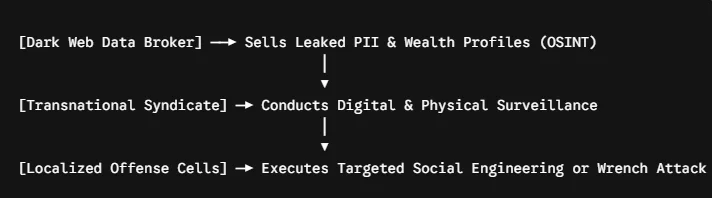
On hidden forums, global coordinate teams recruit localized threat actors, street gangs, and technical hackers to execute hyper-targeted operations against individual keyholders. If an attacker knows your home address, your physical routine, the specific security standards your corporation implements, and the approximate size of your digital custody custody, your multi-million dollar institutional vault is only as secure as your personal perimeter.
The Defensive Countermeasure: Digital Vulnerability Assessments
To address this exact paradigm shift, Nemean Services, powered by the elite operational expertise of Mitmark Intelligence, provides an institutional Digital Vulnerability Assessment (DVA) for enterprise keyholders, single signers, and corporate leadership.
Structural Elimination of the Human Attack Vector
The DVA protocol shifts security from a reactive post-incident posture to active, preventative deterrence by executing through three synchronized layers:
The Proprietary Platform Ingestion: Operating on an advanced infrastructure where custom AI models integrate with years of elite military intelligence and ex-British secret services surveillance expertise. The Platform continuously combs the deep, dark, and surface web to identify exposed Personal Identifiable Information (PII) tied to key signers.
Dynamic Threat Scoring Systems: The system aggregates leaked credentials, geolocational exposure points, and organizational relationship data to calculate a real-time vulnerability index for individual keyholders.
Proactive Information Eradication: Upon discovering exposed data brokers or dark web profiles weaponizing an individual’s footprint, the platform initiates immediate, legal and technical takedown mechanisms, removing unwanted information from source directories before it can be used to coordinate physical or social exploits.
By treating physical personal safety, dark web data privacy, and cryptographic custody as an inseparable, singular security perimeter, Nemean ensures that the people behind the keys are as resilient as the code that shields the assets.